Choosing a commercial cake donut machine is mostly about matching output, consistency, and kitchen workflow. The right model can save labor, speed service, and keep every batch uniform.
In this roundup, we focused on machines that balance production capacity, build quality, temperature control, and ease of cleaning so you can choose with confidence.
Best 10 Commercial Cake Donut Machine Picks for 2026
Compact 6-Hole Donut Baker
6-Hole Commercial Donut Waffle Maker
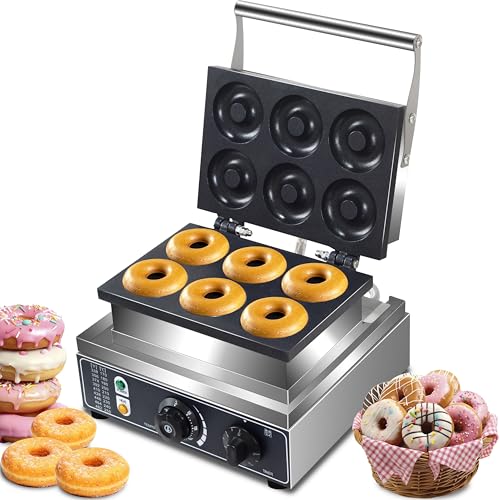
- 1600W dual-sided heating for even baking
- 50°C-300°C temp control and 1-5 minute timer
- Non-stick tray with stainless steel build
Best For: Small bakeries and cafes needing a simple countertop donut baker
Auto-Fry Production Model
VEVOR Single Row Automatic Donuts Machine

- 3000W power for fast, high-volume production
- Automatic flipping reduces manual handling
- Three mold sizes for mini, standard, or large donuts
Best For: High-volume shops that want automated frying and flexible donut sizes
9-Hole Countertop Baker
Commercial 9-Hole Cake Machine

- 2000W double-sided heating for faster baking
- 9-hole capacity suits steady small-shop output
- Simple time and temperature knob controls
Best For: Small commercial kitchens that want a higher-capacity countertop baker
High-Output 6-Row Donut Fryer
VEVOR 360 pcs/hour Automatic Machine

- 6-row layout built for maximum output
- Automatic flipping helps keep donuts consistent
- 304 stainless steel with 4.5L hopper and 9.1L tank
Best For: Shops that need high-volume ring donut production with minimal labor
Rapid-Output Pick
3000W Automatic Donut Maker with 7L Hopper

- 3000W heating for fast operation
- Makes roughly 450-800 donuts per hour
- Includes 3 molds and a 7L hopper
Best For: Busy shops that need automated, high-output donut production
Balanced Commercial Choice

- Up to 360 donuts per hour
- Smart controls for temp and timing
- 304 stainless steel with 4.5L hopper
Best For: Bakeries and cafes wanting a compact automatic donut maker
High-Capacity Flagship
Double-Row Automatic Donut Fryer

- 1200-2300 pieces per hour
- Double-row system with auto counting
- 304 stainless steel and 3 mold sizes
Best For: Large operations that need maximum automation and output
Compact Mini-Donut Automation
FOHERE 1750W Automatic 4-Row Donut Maker

- Fully automatic forming, frying, flipping, and counting
- 3L hopper supports up to 250 donuts per hour
- 304 stainless steel build with safety controls
Best For: Small commercial shops needing compact automated mini-donut production
Industrial High-Output Choice
Kolice Heavy Duty 4-Row Automatic Donut Maker

- Up to 500-1900 donuts per hour
- 30L hopper with 12 molds plus extra mold sets
- Heavy-duty 304 stainless steel build with timer and temp control
Best For: Large-scale operations needing maximum output and sizing flexibility
Compact High-Speed Performer
HNZXIB 1800+ pcs/hour Mini 4-Row Donut Maker

- 1800+ donuts per hour for commercial demand
- 5.5L hopper with 4 molds and 5 thickness gears
- 304 stainless steel body with temperature and timer controls
Best For: Businesses wanting a compact, fast mini-donut machine with precise control
Compact 6-Hole Donut Baker – 6-Hole Commercial Donut Waffle Maker
If you need a commercial cake donut machine that’s simple, compact, and built for steady output, this 6-hole electric baker is a practical pick. Its 1600W double-sided heating, adjustable temperature range, and non-stick surface make it a solid fit for shops that want consistent donuts without the complexity of a full fryer setup.
Best For: Bakeries, cafes, and snack counters that want an easy-to-run donut maker for moderate commercial volume.
Pros:
- 1600W dual-sided heating helps bake donuts evenly and faster.
- Adjustable 50°C-300°C temperature and 1-5 minute timer support different recipes.
- Non-stick tray and stainless steel body make cleanup and daily use easier.
- Compact 6-hole design and stable build suit continuous countertop operation.
Cons:
- Makes only 6 donuts per cycle, so it’s better for smaller batches.
- Plug-and-play design is straightforward, but it does not offer automation.
This is a good choice if your priority is dependable baking performance in a space-saving format. It’s less about maximum throughput and more about controlled, repeatable output for everyday commercial service.
Auto-Fry Production Model – VEVOR Single Row Automatic Donuts Machine
For buyers comparing a commercial cake donut machine alternative that focuses on speed and automation, this VEVOR automatic fryer is aimed at high-volume production. With 3000W power, automated flipping, and three mold sizes, it’s designed to help staff produce consistent donuts quickly with less hands-on work.
Best For: Busy bakeries, cafes, and food stands that need automated donut frying and larger batch output.
Pros:
- 3000W power supports fast donut production in minutes.
- Automatic flipping helps improve cooking consistency with less labor.
- Three size molds add flexibility for mini, standard, and large donuts.
- 304 stainless steel construction with 5.5L hopper and 14.5L oil tank supports commercial use.
Cons:
- It is a fryer-style machine, so it’s less suited to buyers wanting baked cake donuts only.
- Larger footprint and heavier build may require more dedicated counter or floor space.
This machine makes sense when output and automation matter more than simplicity. If your operation needs a fryer-based donut line with minimal manual intervention, this model is built for that workflow.
9-Hole Countertop Baker – Commercial 9-Hole Cake Machine
This commercial cake donut machine is built for shops that want a straightforward countertop baker with a little more capacity. The 9-hole design, double-sided heating, and simple knob controls make it a useful option for bakeries, dessert shops, and restaurants that want consistent results without a steep learning curve.
Best For: Dessert shops, tea houses, and small food service businesses that want a 9-donut batch baker.
Pros:
- 2000W double-sided heating helps shorten bake time.
- Bakes 9 donuts per cycle, giving it more capacity than smaller 6-hole models.
- Time and temperature knobs are simple to adjust and read.
- Stainless steel body, anti-scald handle, and non-slip feet add practical durability and safety.
Cons:
- It is a manual baker, so it won’t match the speed of automatic fryer systems.
- Uses basic knob controls rather than digital presets.
Overall, this is a balanced option for operators who want manageable capacity and reliable control. It’s a good middle ground if you want more output than a 6-hole unit but still prefer a simple countertop machine.
High-Output 6-Row Donut Fryer – VEVOR 360 pcs/hour Automatic Machine
If your priority is volume, this commercial automatic donut machine is built to push out large quantities with less labor. The 6-row layout, intelligent control, and automatic flipping make it a strong fit for operations that need consistent ring donuts at scale.
Best For: High-output bakeries, cafes, and food stands producing ring donuts throughout the day.
Pros:
- 6-row design is built for maximum donut output.
- Automatic flipping supports even cooking with less hands-on work.
- Produces about 50 mm ring donuts with 25 mm thickness for uniform results.
- 304 stainless steel build, 4.5L hopper, and 9.1L oil tank support commercial operation.
Cons:
- It is optimized for ring-style fried donuts rather than cake-style baked donuts.
- Single-setting control is less flexible than machines with wider manual adjustments.
This is the strongest pick here for serious throughput. If your shop needs a fryer-based donut line that can keep up with demand, this machine is focused on efficiency and consistency.
Rapid-Output Pick – 3000W Automatic Donut Maker with 7L Hopper
If you need a commercial cake donut machine built for speed, this 3000W automatic model is designed to streamline shaping, dripping, frying, flipping, and delivering in one workflow. With adjustable time and temperature controls plus three mold sizes, it suits operations that want high throughput and consistent results with less manual handling.
Best For: High-volume cafes, bakeries, dessert shops, and food counters that want automated donut production.
Pros:
- 3000W power supports quick heating and high output.
- Produces about 450 to 800 donuts per hour.
- 7L hopper helps reduce refill frequency during busy service.
- Includes 3 molds for different donut sizes.
Cons:
- Primarily built for commercial settings, so it may be more machine than small shops need.
- Requires oil-temperature and timing setup before use.
Overall, this machine stands out if speed and automation matter most. The combination of smart controls, multiple mold options, and strong hourly output makes it a practical fit for businesses that want to keep donut production moving efficiently.
Balanced Commercial Choice – 6-Row Automatic Donut Maker
This commercial cake donut machine is a strong middle-ground option for shops that want automated production without moving into the largest equipment sizes. Its 6-row system, smart control panel, and stainless steel construction are aimed at steady output, consistent frying, and easier day-to-day operation in a busy kitchen.
Best For: Bakeries, cafes, and donut shops looking for a compact automatic machine with dependable hourly output.
Pros:
- Produces up to 360 donuts per hour with a 6-row automated system.
- Smart control panel supports temperature and timing adjustments.
- 304 stainless steel build is corrosion-resistant and easy to clean.
- 4.5L dough hopper and 9.1L oil tank support continuous operation.
Cons:
- Lower hourly output than larger commercial models.
- Designed mainly for classic ring-shaped donuts.
For businesses that want reliable automation and solid build quality, this model is appealing. It offers a practical mix of output, control, and compactness, making it a sensible choice for kitchens that need professional results without oversized equipment.
High-Capacity Flagship – Double-Row Automatic Donut Fryer
If your priority is a full-scale commercial cake donut machine with serious throughput, this double-row Kolice unit is built for production. It combines forming, dripping, frying, flipping, collecting, counting, and outputting into one system, with adjustable controls and multiple mold sizes for varied donut production.
Best For: Large commercial kitchens, bakeries, and food service operations that need maximum automation and high-volume output.
Pros:
- Double-row design supports high-speed production of 1200 to 2300 pieces per hour.
- Automates forming, frying, flipping, collecting, and counting.
- 304 stainless steel construction is durable and easy to clean.
- Includes 3 mold sizes and multiple control features like temp control and output speed regulation.
Cons:
- Large, heavy machine at 136 pounds, so it needs significant space and setup.
- Uses 220V power and the seller recommends direct circuit breaker connection.
- Default temperature setting is Celsius, which may require attention during setup.
This is the most production-focused option in the group, and it shows in both capacity and feature set. For operations that want a machine to do nearly everything automatically, it delivers a very strong commercial workflow—provided you have the power requirements and space to support it.
Compact Mini-Donut Automation – FOHERE 1750W Automatic 4-Row Donut Maker
If you need a commercial cake donut machine for a smaller counter space, the FOHERE model is built around fast, fully automatic mini-donut production. It handles forming, dropping, frying, flipping, collecting, counting, and outputting, which makes it a practical fit for shops that want steady throughput without a large footprint.
Best For: Cafes, dessert shops, bakeries, and milk tea stores that want compact, automated mini-donut output.
Pros:
- Fully automatic 4-row workflow reduces hands-on operation.
- 3L hopper and 4 molds support up to 250 donuts per hour.
- 304 stainless steel build is durable, hygienic, and easier to clean.
- Includes safety and control features like overheating protection and constant temperature control.
Cons:
- Best suited to mini donuts rather than larger cake donut sizes.
- Lower output than heavier-duty industrial machines.
- Requires oil in the tank before operation.
Overall, this is a solid entry-level commercial option when space, simplicity, and consistent mini-donut production matter most. It is less about maximum volume and more about dependable automated output for everyday shop use.
Industrial High-Output Choice – Kolice Heavy Duty 4-Row Automatic Donut Maker
For buyers comparing a commercial cake donut machine for high-volume production, the Kolice model stands out with its heavy-duty 4-row design and broad donut-size range. It combines forming, dripping, frying, flipping, collecting, and outputting in one system, making it suitable for operations that need serious throughput and more sizing flexibility.
Best For: Large bakeries, cafes, and dessert businesses that need high-capacity automated donut production.
Pros:
- Very high output, listed at up to 500-1900 donuts per hour.
- 30L hopper and 12 molds with additional mold sets increase flexibility.
- 304 stainless steel construction supports sanitation and durability.
- Includes timer, temperature control, overheat protection, and double-switch start protection.
Cons:
- Large footprint and 85 kg weight make it less space-friendly.
- Runs on 220V and 10kW power, so it needs robust electrical support.
- Temperature is set in Celsius and cannot exceed 250°C.
This is the most industrial-style option in the group, and it makes sense if your priority is throughput and versatility rather than compact size. It is a better fit for established production environments than for small storefronts.
Compact High-Speed Performer – HNZXIB 1800+ pcs/hour Mini 4-Row Donut Maker
The HNZXIB commercial cake donut machine is aimed at shops that want fast mini-donut production without giving up too much counter space. It offers all-in-one forming, frying, flipping, and counting, plus 5 thickness settings, so it is a practical pick for businesses that want controlled output and a smaller footprint.
Best For: Cafes, bakeries, restaurants, and dessert shops that need a compact, high-speed mini-donut machine.
Pros:
- 1800+ donuts per hour supports commercial demand.
- 5.5L hopper and 4 molds help with efficient batch production.
- 304 stainless steel construction is durable and easy to maintain.
- Temperature control, timer, and 5 thickness gears improve consistency.
Cons:
- Designed for mini donuts in the 3cm to 5cm range.
- Lower wattage and hopper capacity than larger industrial models.
- Included accessories are limited compared with more feature-rich units.
For operators who want a balance of speed, control, and a smaller chassis, this model is easy to justify. It is especially appealing when the priority is efficient mini-donut production rather than maximum batch size.
How We Picked the Best Commercial Cake Donut Machine
We prioritized Commercial Cake Donut Machine options that offer practical output for real food service use, not just novelty features. That means looking at hourly capacity, heating performance, control precision, materials, and how well each unit fits into a bakery, café, concession stand, or catering setup.
We also favored models with clear operational benefits such as adjustable time and temperature, automatic dispensing or flipping, stainless steel construction, and designs that help reduce inconsistency during busy service periods.
Quick Comparison
For smaller operations, compact 1-row and 2-row machines are usually easier to place and manage. Mid-size 4-row units can be a strong balance of output and footprint. High-volume 6-row systems are better when speed matters most and staff need to produce large quantities continuously.
If your menu requires a classic cake-style donut with consistent ring shape and browning, focus on machines with stable heating and mold control. If you need throughput above all else, choose a commercial unit with automatic feeding and a higher hourly production rating.
Key Buying Factors for a Commercial Cake Donut Machine
Production Capacity
Match the machine’s claimed output to your busiest hour, not your average day. A Commercial Cake Donut Machine should leave headroom for rush periods so you do not bottleneck service.
Heating and Control
Even heating is essential for color, texture, and batch consistency. Adjustable temperature and timer controls are valuable because batter density, ambient conditions, and recipe style all affect results.
Build Quality and Materials
Look for stainless steel and other durable components that can withstand frequent use and routine cleaning. In commercial settings, sturdier construction usually means better long-term reliability.
Ease of Cleaning and Maintenance
Drip management, removable parts, and smooth surfaces can significantly reduce downtime. A machine that is easier to clean is also easier to keep sanitary and ready for service.
Footprint and Power Needs
Before buying, confirm countertop space, ventilation needs, and electrical requirements. Some higher-output machines need more space and a stronger power setup than smaller bakery units.
Who Should Buy Which Commercial Cake Donut Machine?
Small cafes and dessert counters should look for compact machines with simple controls and moderate output. Bakeries and food trucks may prefer mid-range automatic models that balance speed and footprint. High-volume shops, chains, and event-focused operations should lean toward larger multi-row machines built for continuous production.
If you want the most versatility, choose a model with adjustable settings and multiple mold options. If your priority is consistency at scale, a heavier-duty automatic unit is usually the better investment.