Making fresh cider at home does not require a full-size orchard press. The best compact models balance useful capacity with manageable footprints, sturdy frames, and straightforward cleanup.
This roundup compares 10 manual fruit presses and crusher-style tools for small kitchens, home brewing, and occasional seasonal pressing.
Best 10 Cider Presses for Small Kitchens Picks for 2026
Best Crusher for Small-Batch Prep

- 7-liter hopper for home batches
- Creates uniform press-ready fruit pieces
- Durable stainless steel and iron construction
Best For: Home cider makers who already have or plan to add a separate press
Best Large-Batch Wood Press
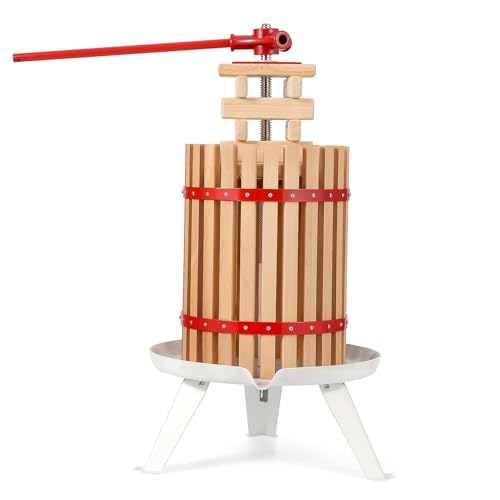
- 18-liter capacity for substantial batches
- Quiet manual T-handle operation
- Designed for cider, wine, juice, and oil
Best For: Users with adequate workspace who process larger quantities of fruit
Best Stainless Steel Press

- Food-grade stainless steel and aluminum alloy
- Stable base with T-handle operation
- Includes filter bag and drainage hose
Best For: Home users seeking a versatile, easy-to-clean manual press
Best Wooden Family Press

- 1.6-gallon capacity for family batches
- Traditional beechwood basket and blocks
- Includes two food-grade filter bags
Best For: Hobbyists pressing prepared fruit for cider, juice, or wine
Best Compact Manual Press
Stainless Steel 2-Litre Ball-Handle Press

- 2-litre capacity for small batches
- Quiet manual operation without electricity
- Suitable for juice, cider, wine, and more
Best For: Small kitchens and occasional pressing
Best Stainless-Steel Capacity
VEVOR 3.36-Litre T-Handle Press

- 3.36-litre inner barrel capacity
- Food-grade stainless-steel construction
- Includes two filter screens
Best For: Versatile home pressing with moderate batch sizes
Best Traditional Basket Press
6-Litre Wooden Apple Cider Press

- Presses about 6 to 8 pounds per batch
- Long pole handle helps reduce effort
- Includes a filter bag
Best For: Home cider batches and traditional-style pressing
Best Compact Stainless-Steel Pick
- Food-contact stainless steel and aluminum construction
- Comfortable T-handle for manual pressing
- Removable parts and included filter bag
Best For: Small-batch cider and juice making at home
Best Stable Small-Batch Press
1.59-Gallon Stainless-Steel Model
- Triangular base helps resist tipping
- Close-fitting plate supports juice yield
- Manual, electricity-free operation
Best For: Stable home pressing of cider and other liquids
Best High-Capacity Option

- Processes about 22 to 33 pounds of fruit
- Wide opening and thick plate support extraction
- Silent, motor-free manual operation
Best For: Larger home batches and small-scale pressing
Best Crusher for Small-Batch Prep – 7L Manual Apple Crusher
For shoppers comparing cider presses for small kitchens, this manual crusher is a practical prep companion rather than a juice press itself. Its 7-liter hopper and compact, table-mount design help turn apples, pears, and other fruit into uniform pieces ready for pressing.
Best For: Home cider makers who need an efficient fruit-crushing step before using a separate press.
Pros:
- 7-liter hopper can hold up to 1.8 gallons of fruit.
- Produces uniform 1/4-inch pieces that are easier to press.
- Food-grade 304 stainless steel with a reinforced iron frame.
- Manual operation and table-mount components suit home or garden use.
Cons:
- It crushes fruit but does not extract juice by itself.
- Hand-wash care is required.
- At 12.5 pounds and nearly 20 inches high, it may need dedicated storage.
This is a useful choice when your small-kitchen cider setup needs consistent pulp preparation. Pair it with a compatible fruit press to complete the process.
Best Large-Batch Wood Press – 18L Solid Wood Fruit Press
Among cider presses for small kitchens, this 18-liter manual model is best suited to cooks with room for a larger work area. Its solid wood barrel, T-handle, and stepwise pressure mechanism are designed for pressing substantial quantities of crushed fruit without a motor.
Best For: Larger household batches, small orchards, gatherings, and users who prioritize capacity over minimal footprint.
Pros:
- 18-liter capacity can handle approximately 22 to 33 pounds of fruit.
- Large pressing plate is designed to improve juice extraction.
- Manual T-handle operation is quiet and does not require power.
- Suitable for cider, wine, juice, and olive-oil pressing.
Cons:
- At 24.9 pounds, it is heavier than the smaller presses in this roundup.
- Its larger capacity may be excessive for very small batches.
- Manual assembly is required.
This press can save time when processing a substantial harvest, but its size makes it less convenient for cramped counters. Measure your storage and operating space before choosing it for a small kitchen.
Best Stainless Steel Press – 6L Manual Fruit Juicer Press
For cider presses for small kitchens, this 6-liter stainless steel model balances useful capacity with a relatively manageable 10.4-pound weight. The removable basket, collection barrel, filter bag, and drainage hose make it a practical all-in-one option for pressing prepared fruit.
Best For: Home users who want a rust-resistant manual press for cider, juice, wine, berries, vegetables, or herbs.
Pros:
- Food-grade stainless steel and aluminum alloy construction.
- 6-liter outer barrel with a 4-liter perforated inner basket.
- Triangular base and three support columns help stabilize operation.
- Removable parts, filter bag, and silicone drainage hose simplify use and cleanup.
Cons:
- Hand washing and disassembly are required for cleaning.
- The inner basket capacity is 4 liters, less than the outer barrel capacity.
- Hard fruit may need preparation before pressing.
Its corrosion-resistant materials and included accessories make this a well-rounded fit for regular home pressing. The 6-liter capacity is more kitchen-friendly than the largest model while still supporting useful batches.
Best Wooden Family Press – 6L Beechwood Cider Press
This 6-liter beechwood model is a straightforward option for shoppers looking at cider presses for small kitchens, especially those who prefer a traditional wooden design. Its extended handle, progressive screw, filter bags, and triangular base support small family batches of prepared fruit.
Best For: Families and hobbyists pressing apples, grapes, berries, and other pre-cut fruit for juice, cider, wine, or pulp.
Pros:
- 6-liter, 1.6-gallon capacity suits family gatherings and home batches.
- Natural beechwood basket and pressing blocks provide a traditional design.
- Extended handle and spiral mechanism are intended to reduce effort.
- Includes two food-grade filter bags and a stable triangular base.
Cons:
- Hard fruits must be crushed before pressing.
- At 22.64 inches tall, it may be tall for some counters or cabinets.
- Hand-wash care is specified.
This press offers a good middle ground between household capacity and manual simplicity. Keep in mind that apples and other hard fruit require a separate crusher or prep step before they go into the press.
Best Compact Manual Press – Stainless Steel 2-Litre Ball-Handle Press
For shoppers comparing cider presses for small kitchens, this 2-litre manual model offers a compact-capacity option for fresh juice, cider, wine, and other small-batch pressing tasks. Its ball-style handle is designed to provide leverage without electricity.
Best For: Small households and occasional batches of fruit, vegetable, cheese, or herb pressing.
Pros:
- 2-litre capacity suits smaller pressing jobs.
- Manual, electricity-free operation is quiet at about 35 dB.
- Stainless-steel and iron construction is listed as rust resistant.
- Dishwasher-safe care is specified.
Cons:
- Its smaller capacity is less suitable for processing large harvests.
- The listed dimensions are relatively tall at 31 inches.
The stable triangle-style ball handle and broad food-use range make this a practical choice when quiet, hands-on pressing matters more than maximum throughput.
Best Stainless-Steel Capacity – VEVOR 3.36-Litre T-Handle Press
Among cider presses for small kitchens, this VEVOR model balances a countertop-friendly footprint with a 3.36-litre inner capacity. The adjustable T-handle and included filter screens are designed for manual fruit and vegetable pressing.
Best For: Home users who want a sturdy stainless-steel press for cider, juice, wine, and several specialty foods.
Pros:
- Food-grade stainless-steel press plate, barrels, and filter screens.
- 3.36-litre inner capacity provides more room than a small 2-litre press.
- Disassembles for cleaning and includes dishwasher-compatible components according to the notes.
- Can also handle cheese, puree, olive oil, and herbs.
Cons:
- Hard fruits such as apples and carrots must be mashed before pressing.
- Grapes and oranges need to be peeled and cut into small pieces.
- Product-care details also list hand washing, so dishwasher use may require checking the specific component.
Its metal base, T-handle, and larger inner barrel make it a versatile middle-ground option, provided you are willing to prepare firm produce before loading it.
Best Traditional Basket Press – 6-Litre Wooden Apple Cider Press
For cider presses for small kitchens where a traditional look and larger batch size are priorities, this SQUEEZE master model uses a solid wood basket and long pole handle. It can press about 6 to 8 pounds of fruit at one time.
Best For: Families, parties, and home users who want a traditional fruit press for apple cider and other fruit-based drinks.
Pros:
- 6-litre capacity handles roughly 6 to 8 pounds of fruit per batch.
- Long, spiral-style pole handle is designed to reduce pressing effort.
- Thick press plate and larger stressed area support thorough extraction.
- Includes one filter bag and can press fruit, wine residue, oil pomace, and honeycomb.
Cons:
- Assembly is required.
- The wood construction may need more careful maintenance than an all-stainless model.
- Its larger basket may take more storage space than compact presses.
This is the most traditional and highest-capacity option in the group, making it appealing for cider-focused batches, though its assembly and wood construction may be less convenient for very limited counters.
Best Compact Stainless-Steel Pick – 1.6-Gallon Manual Fruit Press
For shoppers comparing cider presses for small kitchens, this 1.6-gallon manual model offers a manageable capacity with food-contact stainless steel components and a compact, hand-operated design. Its removable parts and smooth surfaces also make cleanup more practical after pressing apples, fruit, vegetables, herbs, or honey.
Best For: Small-batch cider, juice, cheese, honey, herb, or olive-oil pressing at home.
Pros:
- Food-contact stainless steel and aluminum alloy construction with rust resistance.
- Ergonomic T-handle is designed for a comfortable, steady grip.
- Removable main parts and a smooth surface simplify rinsing and cleanup.
- Includes a filter bag and silicone hose tube.
Cons:
- Manual operation requires hand effort.
- Hand-wash care is specified.
- The 1.6-gallon capacity is intended for smaller batches rather than high-volume pressing.
This is a practical choice when kitchen-friendly cleaning and corrosion-resistant materials matter more than maximum batch size. The included accessories add convenience for first-time home pressing.
Best Stable Small-Batch Press – 1.59-Gallon Stainless-Steel Model
This 1.59-gallon stainless-steel press is a strong contender among cider presses for small kitchens when stability is a priority. Its triangular base and three-column structure are designed to reduce tipping during operation, while the perforated basket and close-fitting press plate aim to improve juice yield.
Best For: Home users who want a stable manual press for cider, fruit juice, cheese, herbs, honey, or olive oil.
Pros:
- Triangular base and three columns provide a stable operating structure.
- Perforated stainless-steel basket and close-fitting press plate are designed to limit leakage.
- Ergonomic T-handle supports straightforward manual operation.
- Manual pressing uses no electricity and may reduce fruit oxidation compared with electric extraction.
Cons:
- Manual pressing requires physical effort.
- The listed capacity is about 1.59 gallons, limiting batch size.
- At 10.4 pounds, it may be substantial to move or store in a small kitchen.
Choose this model if a steady base and a stainless-steel pressing basket are more important than portability. It balances a small-batch format with features aimed at efficient juice extraction.
Best High-Capacity Option – 3.2-Gallon Wood-Basket Press
Although larger than most cider presses for small kitchens, this 3.2-gallon manual press suits shoppers who want to process more fruit per batch. Its solid wood basket, wide opening, thick pressing plate, and stepwise pressure mechanism are designed for pressing approximately 22 to 33 pounds of fruit without a motor.
Best For: Larger home batches, gatherings, small shops, restaurants, and small-scale fruit pressing.
Pros:
- 3.2-gallon capacity and wide opening accommodate larger loads.
- Wide, thick pressing plate is designed to support higher juice yield.
- Manual, motor-free operation is silent during use.
- Includes one filter bag and is designed for straightforward assembly.
Cons:
- At 22.9 pounds, it is less convenient for frequent kitchen storage or movement.
- The larger footprint may be difficult to accommodate in a small kitchen.
- Manual operation still requires physical effort, despite the stepwise pressure design.
This is the best fit for buyers who regularly press larger quantities and have suitable storage or counter space. For occasional small batches, its size and weight may be more than necessary.
How We Picked the Best Cider Presses for Small Kitchens
We focused on manual presses and compact crusher combinations that suit limited counter, pantry, or garage space. The selected models cover common capacities from roughly 2 to 18 liters, along with stainless-steel, wood-basket, and mixed-material designs. We considered pressing capacity, frame stability, handle ergonomics, basket construction, cleanup, portability, and how easily each unit can be stored between harvests.
Because product specifications and included accessories can vary, check the current listing for exact dimensions, filter-bag contents, assembly requirements, and food-contact materials before buying.
Quick Comparison
| Type | Typical capacity | Best for | Main advantage |
|---|---|---|---|
| Small herb or cheese press | About 2 liters | Very small batches | Easy storage and handling |
| Compact fruit press | About 6 liters | Regular home use | Good balance of output and footprint |
| Mid-size wood press | About 12 liters | Seasonal cider making | More batch capacity |
| Larger manual press | About 18 liters | Families or heavier harvests | Fewer pressing cycles |
Key Buying Factors for Cider Presses for Small Kitchens
Capacity and Storage
Choose a basket size based on your typical batch, not your largest possible harvest. A 2- to 6-liter press is easier to move and store, while 12- to 18-liter models reduce repeated loading but need more floor or counter space.
Crusher Versus Press
A press extracts juice from prepared, crushed fruit. If you are starting with whole apples, you may also need a scratter, grinder, or crusher. Combination tools can save space, but dedicated equipment may process fruit more efficiently.
Materials and Construction
Stainless steel is generally easy to wash and well suited to frequent use. Wooden baskets can feel traditional and provide generous capacity, but they need thorough drying to prevent lingering moisture and odors. Look for a stable base, rigid frame, and a handle that turns smoothly under load.
Cleanup and Juice Control
Filter bags can help contain pulp and simplify cleanup, although they must be washed and dried promptly. Confirm whether the basket, tray, and pressing components are removable, and plan for a container that fits beneath the juice outlet.
Who Should Buy Which Cider Presses for Small Kitchens?
Choose a small 2-liter model if you press herbs, berries, cheese, or occasional test batches and have very limited storage. A 6-liter stainless-steel press is the most versatile choice for many apartment kitchens and home brewers. Select a 12-liter unit when you regularly process garden or orchard fruit but still want a manageable manual setup. An 18-liter press makes more sense for larger seasonal batches, provided you have a sturdy work surface and room to store it.
For whole apples, prioritize a model paired with a crusher or budget separately for one. For the easiest maintenance, favor removable stainless-steel parts and a simple frame. Whichever size you choose, press only clean, prepared fruit and follow the manufacturer’s sanitation and load instructions.